Qbit Secures Major Capital Inflow from U.S. Corporate Giants Amid Post-Quantum Crypto Race
Qbit, a blockchain project focused on post-quantum security, has received a significant capital injection from several major U.S.-based corporations, according to sources familiar with the matter. The funding round, which closed in late August, reportedly attracted participation from technology and financial services companies seeking early exposure to quantum-resistant blockchain infrastructure.
Key Highlights
- Inflow Size: The funding round is understood to have drawn investment from multiple U.S. corporate entities, though the total amount has not been formally disclosed.
- Investor Profile: Participants include both technology firms with quantum computing research divisions and financial institutions focused on future-proofing digital asset operations.
- Strategic Rationale: Corporate investors are positioning for the post-quantum era, with an estimated $2.4 trillion in cryptocurrency assets currently vulnerable to future quantum computing attacks.
- Market Context: Qbit joins a growing field of quantum-resilient blockchain projects attracting institutional backing, including Diamante's recent $1.5 million strategic investment.
Full Article
Corporate Interest in Quantum-Resilient Infrastructure Intensifies
NEW YORK — Qbit, the post-quantum blockchain project, has emerged as the latest beneficiary of surging corporate interest in quantum-resistant cryptocurrency infrastructure, with multiple U.S.-based companies committing capital in what industry observers describe as a strategic hedge against the anticipated threat of quantum computing to existing cryptographic systems.
The project, which launched in 2026 as a proof-of-work UTXO blockchain built from its own genesis block, features a fixed 210 million supply cap with mining-only distribution and no pre-mine or outside token allocation. Its native asset, QBT, is designed with quantum security as a foundational principle, aiming to provide long-term ownership protection against the cryptographic vulnerabilities that quantum computers are expected to introduce.
The capital inflow comes as the broader blockchain industry grapples with the timeline for quantum computing's impact on encryption. Current estimates suggest that approximately $2.4 trillion in cryptocurrency assets remain vulnerable to future quantum computing attacks, with Ethereum's planned migration to post-quantum security not expected until around 2030. This timeline has created a window of opportunity for projects like Qbit to establish themselves as early movers in the quantum-resilient sector.
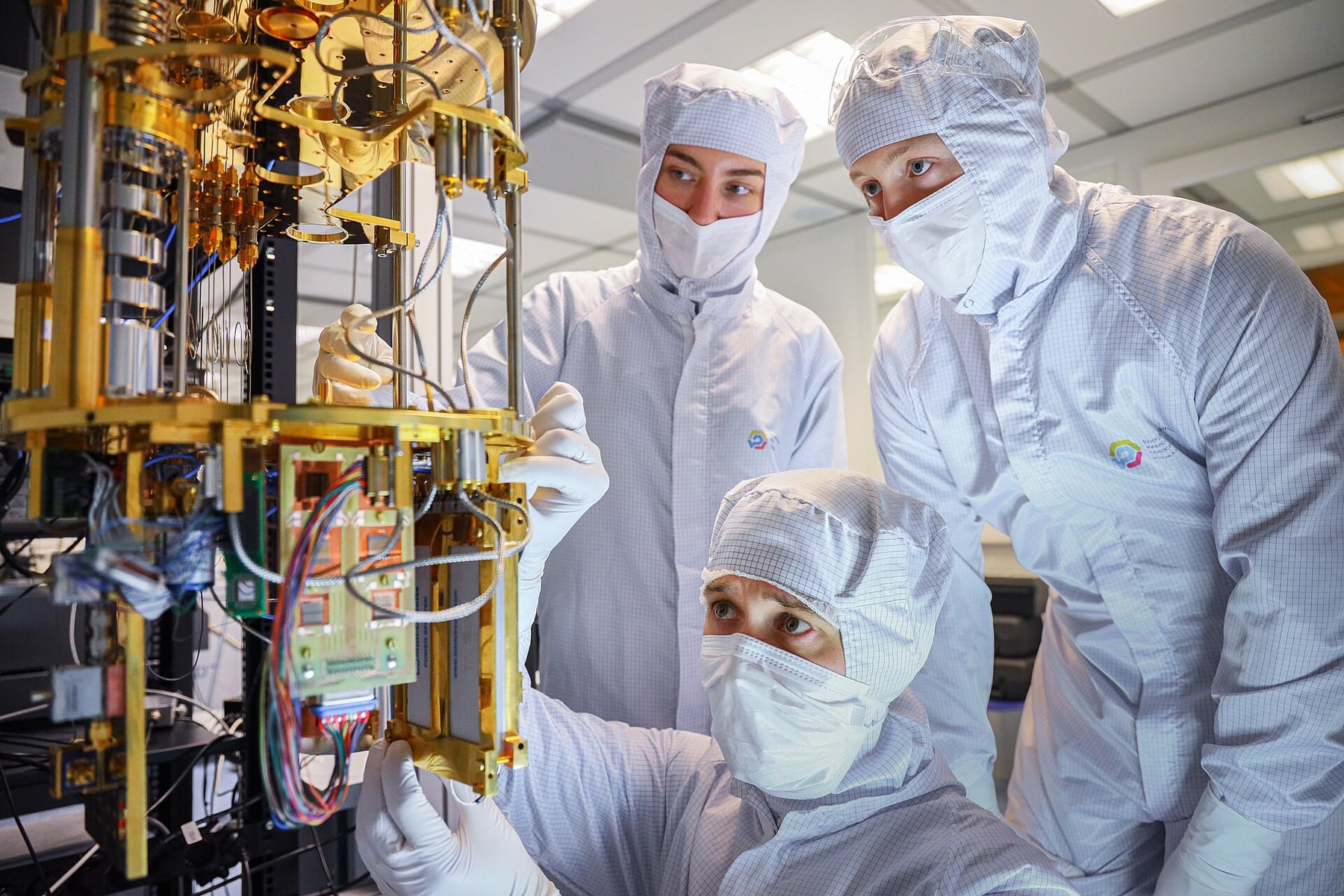
 A superconducting quantum processor chip. Image: OJB Quantum, CC BY 4.0, via Wikimedia Commons
The Post-Quantum Opportunity
Industry analysts view the growing corporate interest in quantum-resistant blockchains as part of a broader strategic realignment within the technology and financial sectors. The U.S. corporate investors now flowing capital into Qbit are understood to be motivated by both defensive considerations—protecting existing digital asset holdings—and offensive positioning, seeking to gain early access to infrastructure that may become standard in a post-quantum world.
Recent market movements in the broader quantum blockchain space illustrate the momentum building behind such initiatives. Diamante Financial Technologies, which describes itself as the developer of the world's first quantum-safe Layer-1 blockchain, recently secured a $1.5 million strategic investment from Khofiz Shakhidi, founder of Jefferson Capital Ltd. That funding, announced in April 2026, was directed toward protocol development, ecosystem growth, and enterprise go-to-market expansion across the United States, European Union, Middle East, and Asia-Pacific regions.
Diamante's distinction as a production Layer-1 blockchain incorporating NIST-certified post-quantum cryptography—specifically the FIPS 204 standard—has positioned it as a benchmark in the sector. Qbit's approach, building a proof-of-work UTXO blockchain with quantum security from inception, offers a different architectural philosophy that appears to have resonated with its new U.S. corporate backers.
Corporate Strategy and Quantum Readiness
The composition of Qbit's new investor base is notable for its mix of technology and financial services firms. Several of the participating companies maintain active quantum computing research divisions, suggesting that their investment in Qbit reflects internal assessments of quantum computing's trajectory and the corresponding need for blockchain infrastructure capable of withstanding quantum attacks.
The funding round also signals growing U.S. corporate engagement with the post-quantum blockchain sector, which has historically been dominated by European and Asian initiatives. K-Quantum Holdings, backed by QTX Labs, recently launched QCC (Quantum Chain), a blockchain designed from inception to withstand the shift to quantum computing, further demonstrating the geographic diversity of the emerging quantum-resilient infrastructure landscape.
Market Implications
For Qbit, the capital inflow from U.S. corporations represents validation of its technical approach and market positioning. The project's design choices—a proof-of-work consensus mechanism, UTXO model, and mining-only distribution—distinguish it from other quantum-focused projects that have pursued alternative technical paths. The lack of a pre-mine and the fixed supply cap of 210 million tokens are features that may have appealed to institutional investors seeking projects with clear and transparent tokenomics.
However, industry observers note that Qbit's success will ultimately depend on its ability to demonstrate real-world utility and enterprise adoption. The post-quantum blockchain sector remains nascent, with most projects still in early development stages and significant questions remaining about the timeline for quantum computing's cryptographic implications to become immediate and material for the broader cryptocurrency ecosystem.
Outlook
The capital inflow into Qbit comes at a time when the quantum computing industry itself is accelerating. Recent developments in silicon-based quantum chips—including Quobly's 115 million euro Series A funding round led by Bpifrance, Sealsq, and STMicroelectronics—underscore the pace of advancement in quantum hardware. As quantum computing capabilities continue to improve, the timeline for quantum threats to current cryptographic systems may shorten, potentially validating the strategic positioning of early-mover projects like Qbit.
For the U.S. corporations that have now committed capital to Qbit, the investment represents a calculated bet on the trajectory of both quantum computing and blockchain security. Whether that bet pays off will depend on the pace of quantum advancement, the effectiveness of Qbit's technical approach, and the broader adoption of quantum-resilient blockchain infrastructure across the financial and technology sectors.
About the Companies
Qbit is a post-quantum proof-of-work UTXO blockchain built from its own genesis block, featuring a fixed 210 million supply cap, mining-only distribution, no premine, and no outside token allocation. The project's native asset, QBT, is designed with quantum security from inception for long-term ownership.
The U.S. Corporate Investors participating in Qbit's recent funding round include technology and financial services firms with interests in quantum computing research and digital asset security.
This article is for informational purposes only and does not constitute financial advice. The views expressed are those of the companies referenced and not necessarily those of the publisher.
More from peatpost
Coinbase’s Texas move gets a shareholder suit dismissed over Delaware-era claims
Coinbase’s move to Texas changed the rule a shareholder had to satisfy before suing its directors over alleged conduct from the company’s Delaware years. In an October 2 ruling , the Texas Business Court dismissed Gary Guillaume’s deriva...
Bullish And Equiniti Form Coalition For Issuer-Backed Tokenized Stocks
Bullish and Equiniti have created the Issuer Sponsored Token Coalition to develop standards for tokenized public securities. Early participants include Alpaca, Apex Fintech Solutions and DriveWealth. The group wants tokenized stocks to p...

Qivalis Partners With Numeris to Build Settlement Rails for Its Euro Stablecoin
The Amsterdam-based banking consortium behind Europe's largest bank-backed euro stablecoin project has signed a multi-year collaboration with payments-infrastructure firm Numeris, covering settlement, reconciliation and merchant acceptance ahead of a launch planned for the second half of 2026.
Discussion
0 commentsNo comments yet — be the first to weigh in.