My Home State Is About to Hand the German Far Right Its Breakthrough
Saxony-Anhalt could become the first state government led solely by the AfD. The disaster has been decades in the making.

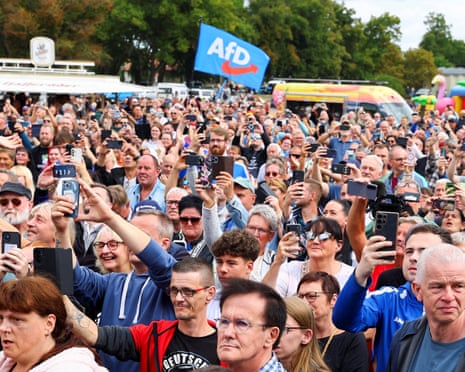
It was in the summer of 2004 that the historian Marcus Böick stopped understanding his own people. He was standing on a sweltering market square in Aschersleben, the town where he was born, on the northern edge of the Harz mountains. A large crowd had gathered in front of a stage to protest against the welfare reforms — or, as many there saw them, welfare cuts — introduced by Gerhard Schröder's Social Democratic-Green coalition.
They chanted "We are the people!" and waved handpainted placards.
The phrase that changed owners
That chant is the whole story compressed into four words.
"Wir sind das Volk" belonged to the demonstrators of 1989, the crowds in Leipzig and Dresden who faced down a state that claimed to rule in their name. It was a democratic assertion made at genuine personal risk, and it worked.
Fifteen years later it was being used against a democratically elected government by people who felt that democracy had stopped delivering for them. Two decades after that, it belongs to a party the German domestic intelligence service has placed under observation.
The words did not change. What changed was who felt entitled to speak for the people, and against whom.
What Saxony-Anhalt would mean
On 6 September, Saxony-Anhalt may become the first German state governed solely by the AfD. Not a coalition partner, not a blocking minority — a government.
The significance is not principally about what one state administration can do. It is that the firewall other parties have maintained since the AfD's founding, the refusal to cooperate with it in government, would have been rendered irrelevant rather than broken. A party that wins outright does not need anyone's permission.
The grievance is real
The temptation for western commentators is to treat this as a moral failure of the east, and that reading is both comfortable and wrong.
Eastern Germany experienced something without parallel in postwar Europe: the near-total dismantling of an industrial economy in under a decade, administered largely by westerners, followed by three decades in which the region's wages, pensions, property ownership and representation in national institutions remained persistently below the west's. Whole towns lost their young people. A generation was told its working life had been worthless.
A sense of abandonment on that scale does not require an explanation involving character. It requires an explanation involving policy, and there is one.
Why the AfD is still the wrong answer
None of which makes the vote a solution. The party's promises are hollow in a specific and demonstrable way.
Saxony-Anhalt's problems are demographic and economic: an ageing population, a shrinking workforce, industries that need skilled labour the region cannot supply internally. The AfD's central offer — sharply reduced immigration — directly worsens the labour shortage that is the binding constraint on the state's economy.
A party elected on abandonment will preside over a state with fewer workers, less investment and a reputation that deters both. The frustration is legitimate; the remedy will make the underlying situation worse, and the people who bear that will be the same people who have borne everything else.
What the other parties failed to do
The firewall was a defensive measure that never came with an offer attached.
Refusing to govern with the AfD is a statement about the AfD. It is not a policy for Saxony-Anhalt, and it does nothing about wages, depopulation or the closure of the last bank branch in a town of four thousand people. Voters were told repeatedly who they should not vote for and comparatively rarely what would change if they did not.
That asymmetry is how protest votes become governing majorities. A cordon works while the party inside it is small and the parties outside it are delivering something. It fails when neither condition holds, and both have now stopped being true at once.
More from peatpost

Texas Court Dismisses Coinbase Shareholder Suit Over Delaware-Era Conduct
The Texas Business Court applied the state's written-demand rule after Coinbase reincorporated, even while assuming Delaware law governed the underlying claims.

Bullish and Equiniti Form Coalition for Issuer-Sponsored Tokenised Stocks
Alpaca, Apex Fintech Solutions and DriveWealth are early members of a group that wants tokenised shares to preserve the direct link between companies and their shareholders.
Qivalis Partners With Numeris to Build Settlement Rails for Its Euro Stablecoin
The Amsterdam-based banking consortium behind Europe's largest bank-backed euro stablecoin project has signed a multi-year collaboration with payments-infrastructure firm Numeris, covering settlement, reconciliation and merchant acceptance ahead of a launch planned for the second half of 2026.
Discussion
0 commentsNo comments yet — be the first to weigh in.