Seeing Bitcoin's Gains Made People Likelier to Own Crypto, Cleveland Fed Paper Finds
People shown Bitcoin's 14.3% annual return were about 2.5 points likelier to own crypto later, and those who knew least about it reacted most.
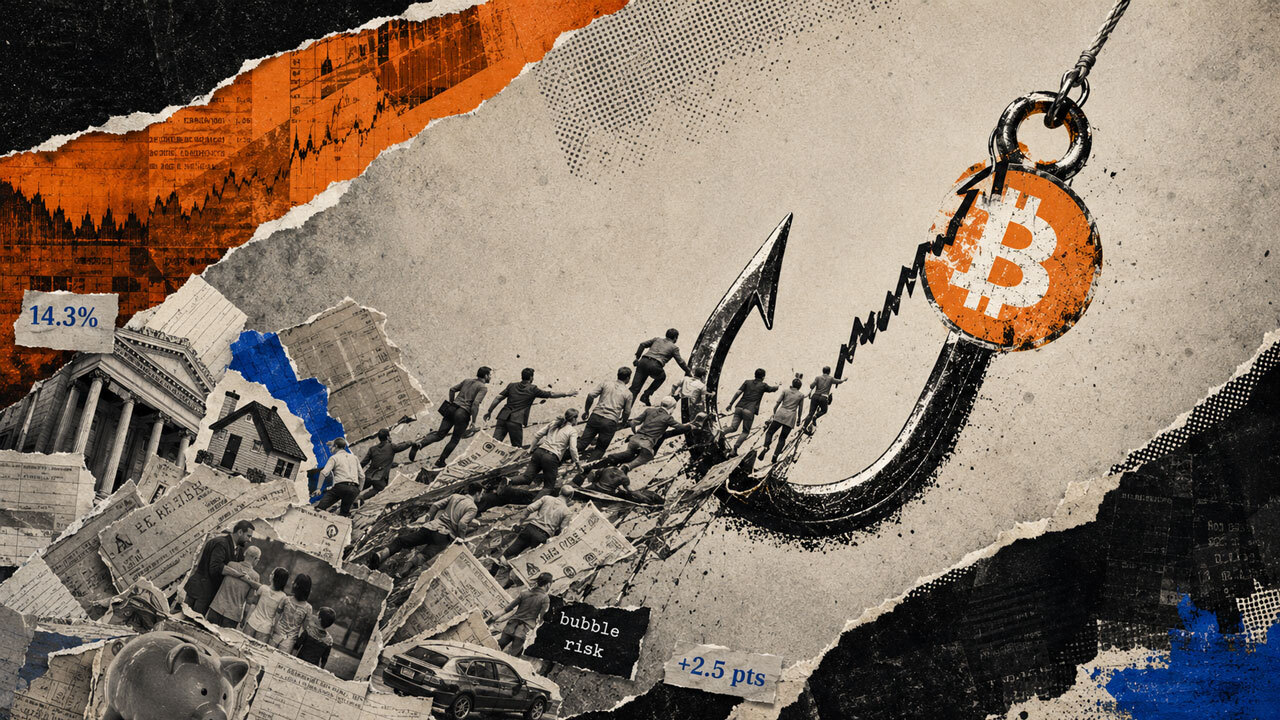
Information about Bitcoin's recent gains made people more optimistic about crypto and more likely to own it when they were surveyed again, according to an experiment described in a Federal Reserve Bank of Cleveland working paper.
Participants shown how Bitcoin had performed over the previous 12 months were about 2.5 percentage points more likely to report holding crypto in a follow-up survey, CryptoSlate reported. Given that about 11% of respondents already held crypto beforehand, the shift represents a rise of roughly 23% in the likelihood of ownership.
Economists have long suspected that recent performance feeds into investors' forecasts and then into their portfolios. Controlled tests of that link are uncommon, which gives the result added weight.
How the experiment worked
The paper, Do You Even Crypto, Bro? Cryptocurrencies in Household Finance, was written by Michael Weber with co-authors Bernardo Candia, Olivier Coibion and Yuriy Gorodnichenko and released in July 2026. They conducted the experiment in the second quarter of 2025.
Respondents were randomly split into groups. One was told that Bitcoin had returned 14.3% over the preceding year, while another saw a chart of its price over the same span. Other groups were briefed on the S&P 500, on GameStop, or on the inflation outlook of the Federal Open Market Committee, while a control group got nothing extra.
The plain number moved expectations more than the picture. Compared with the control group, people given the exact return lifted their one-year forecast for crypto returns by 3.2 percentage points, against roughly 1.2 points for those who saw the chart.
Both Bitcoin treatments raised the share people wanted to put into crypto by roughly 2 percentage points; in the control group, the average desired allocation was 4.3%. Most of that extra allocation would have been drawn from money otherwise kept in checking or savings accounts, or held as cash.
On actual ownership, the return group was 2.41 points more likely to report holding crypto later and the chart group 2.48 points more likely. Because few respondents changed status, the researchers pooled the two groups, producing a p-value of 0.017, below the 5% threshold economists commonly use for statistical significance.
Information about the S&P 500 also made participants more likely to own crypto later. A GameStop chart raised desired allocation but did not significantly change subsequent ownership.
Newcomers were the most responsive
The strongest reaction came from people who knew little about the asset class. About 40% of non-owners said their knowledge of crypto was limited, and close to 90% of that group would not put a number on expected returns.
That less-informed group was among the most responsive to the Bitcoin information. Participants who already regarded crypto as a poor investment, by contrast, barely adjusted their allocations.
The finding implies that price run-ups resonate most with people still making up their minds about crypto, rather than with sceptics or existing holders.
Beliefs outweigh demographics
The paper also draws on the Nielsen Homescan Panel, which follows tens of thousands of US households. Crypto ownership among respondents rose from roughly 3% in 2021, reaching about 11% a year later and around 12% by the middle of 2023. It later dropped by several percentage points before recovering to about 12% in 2025, when Bitcoin traded above $120,000.
Owners consistently expected more from crypto than non-owners. In a 2021 survey, holders anticipated returns of about 22% over the following year against roughly 7% for non-holders; in 2025 the figures were 13.8% and about 4.7%.
Expected returns and perceived risk had roughly twice the explanatory power of detailed demographic data. Age was the widest demographic divide: after controls, people under 40 were 13 points more likely to own crypto than those over 60. Men were about 4 points more likely than women, and higher income, employment and financial wealth were also linked to ownership.
Gains showed up in spending, too. For a hypothetical household with its entire financial portfolio in crypto, a doubling of Bitcoin's price raised the probability of buying a durable good that quarter by 1.4 percentage points. The effect was clearest for big, infrequent purchases such as computers and refrigerators, and it faded the following quarter. The authors compared the pattern with how households spend temporary windfalls such as gambling winnings.
What the study does not show
The Cleveland Fed classifies the paper as preliminary, and the views in it belong to the authors rather than to the bank or the Federal Reserve System.
Its claims about prices are also limited. The experiment does not show that every rally draws in the same amount of new demand, does not measure any effect on prices, and says nothing about whether Bitcoin is overvalued or whether new retail buyers keep rallies going.
The authors did note that extrapolating recent returns can contribute to asset-price bubbles. That is the tension in the findings: the mechanism that broadens participation can also amplify momentum.
As a working paper, the results may yet be revised. A natural next question is whether the effect looks the same when recent returns have been poor.
More from peatpost

Real Estate Market Forecast 2026: U.S., Spain, Italy and Switzerland Face a Changing Landscape as Crypto Enters the Property Market
Global housing markets diverge in 2026 as mortgage rates ease, supply shortages persist, and blockchain-based transactions move from pilot projects toward mainstream adoption.
Clarity Act Odds More Than Doubled to 31% as Trump Reportedly Backed Ethics Limits
The crypto market structure bill needed 60 Senate votes to reach floor debate; supporters likely required nine Democrats, and none had publicly committed.

India to push BRICS digital currency link despite hurdles, sources say
India is chairing BRICS this year, with leaders of the bloc set to meet in New Delhi on September 12 to 13.
Discussion
0 commentsNo comments yet — be the first to weigh in.