China Recalls Four Million Cars Over Door Handles
The country's largest ever recall, mostly Teslas, lands ahead of rules requiring mechanical releases inside and out.
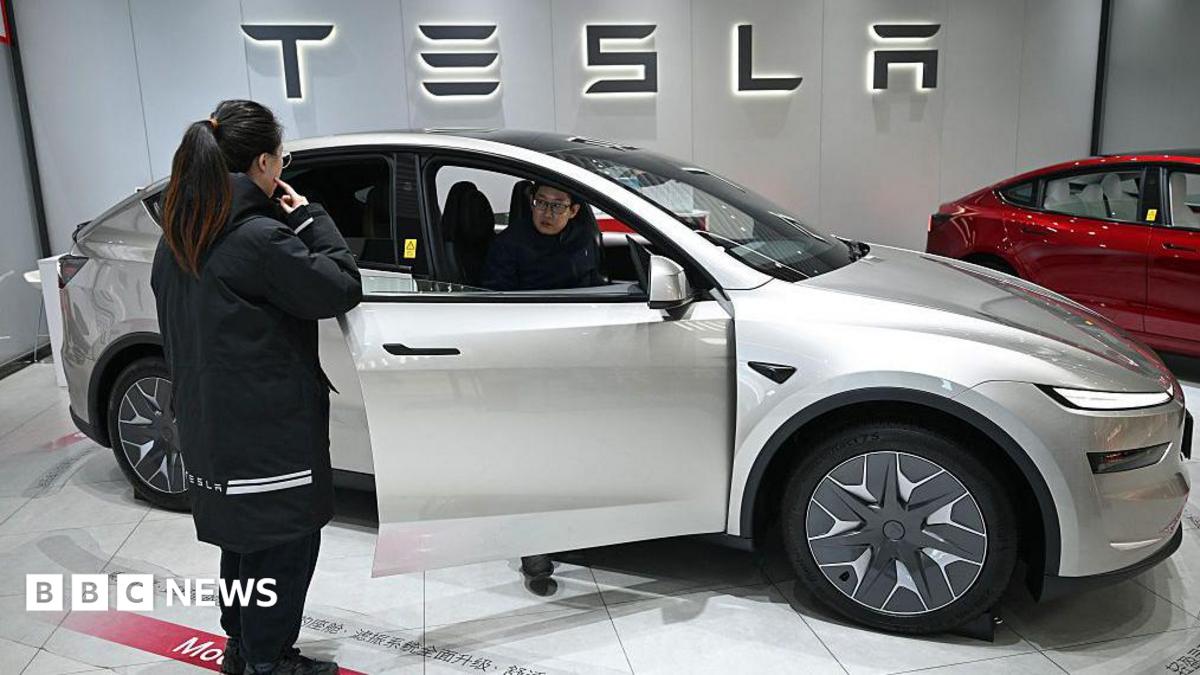
Hidden door handles — the flush designs common on electric vehicles — have come under scrutiny after China announced its largest ever car recall, covering more than four million vehicles, most of them Teslas.
The recall precedes new Chinese regulations requiring cars to have a mechanical release on both the inside and the outside of their doors.
How the design spread
Popularised by Tesla, the concealed handle has become commonplace worldwide. In China it appears on roughly 60% of the hundred best-selling new energy vehicles, a category covering both electric cars and hybrids.
The appeal is straightforward: the minimalist design gives a vehicle a "sleek look and reduces wind drag," as the industry analyst Stephen Dyer of AlixPartners puts it. Aerodynamic drag is the dominant consumer of energy at motorway speed, and on an electric car every fraction of a percent converts directly into range — the number manufacturers compete on hardest.
But Dyer adds a caveat from personal experience. "Even I often find it difficult to locate the switch to open the door from the inside of an unfamiliar vehicle," said Dyer, who is based in Shanghai.
From awkward to dangerous
Usability is the mild version of the complaint. The serious one is that electronically actuated handles can fail exactly when they are needed.
Electronically powered door handles became an industry trend but raised "real safety concerns" when doors failed to open promptly, delaying rescue after accidents, according to Lyu Chen, an associate professor at Nanyang Technological University.
"A door handle may seem simple, but it becomes safety-critical in the seconds after a crash," Chen said.
The difficulty compounds for anyone outside the vehicle. A bystander or first responder attempting to reach an occupant has to identify an unfamiliar release mechanism on a car that may have lost power, in poor light, under time pressure — a set of conditions no showroom demonstration replicates.
The cases behind the rule
The Chinese carmaker Xiaomi faced intense scrutiny after two fatal crashes in 2025 involving its SU7 model, where suspected electrical failures allegedly trapped occupants.
One crash on a highway in Tongling, eastern China, killed three people, according to regional coverage cited by the state-controlled Global Times. Relatives of the victims said the passengers were stuck inside because the doors could not be unlocked after the collision.
Xiaomi said at the time that the SU7 had mechanical emergency releases that work without power, located at the bottom of each door, and that it was investigating and cooperating with police. The latest SU7 models ship with new handles that open without power.
That response is revealing in itself: a manual release existed, at the bottom of the door, where an occupant in an emergency was unlikely to know to look for it. A safety feature that requires prior knowledge of its location is not much of a safety feature.
Tesla has also faced litigation in the United States over its handle design, including a suit brought by the sole survivor of a crash.
The pattern this exposes
The regulatory response is unusually direct. Rather than mandating a performance standard and letting manufacturers meet it however they choose, China is specifying a physical mechanism: a mechanical release, inside and outside, that works without electricity.
That is a rejection of a broader design philosophy rather than of one component. Flush handles are part of a wider move to replace mechanical linkages with electronic actuation across the car — a trend that improves aerodynamics, cost and styling, and quietly introduces a dependency on power at the moment a crash is most likely to have removed it.
Four million vehicles is the price of discovering that in production rather than in testing.
More from peatpost
'Clearly, People Hate Data Centers': Altman Concedes the Backlash
Seven in ten Americans oppose one being built near them. At least 48 projects worth $156bn have already been blocked or stalled.

Former Barclays Chief Questioned Under Oath Over Epstein Emails
Newly released transcripts show US lawmakers pressing Jes Staley on 2010 exchanges. He denies the central allegation.
Nvidia's $12.9bn Move for Hugging Face Would Put Silicon and Distribution Under One Roof
The largest GPU maker buying the largest open-model hub would concentrate the entire open-source AI pipeline inside one company.
Discussion
0 commentsNo comments yet — be the first to weigh in.