Young Workers Are Leaving the Digital Economy for Bookbinding
Entry-level white-collar jobs are being automated. Some graduates are answering with centuries-old crafts that AI cannot do.

It is a bleak moment for young people entering the workforce. For decades a university degree seemed to promise a stable career, but entry-level white-collar jobs across almost every sector are being disrupted by AI. Trainee accountants, software engineers and junior lawyers increasingly find themselves displaced by cheap automation, and even creative fields are struggling against systems that generate artwork, long-form prose or complex design briefs in seconds.
Some young workers have responded by moving in the opposite direction entirely — into what they see as AI-proof heritage crafts: centuries-old, hands-on trades such as boatbuilding, metalwork and bookbinding that depend on specialist knowledge, creative judgement and manual dexterity.
The calculation
Eryn Lawley, a 27-year-old politics graduate, decided that future-proofing her career meant leaving the digital world. She is now a second-year apprentice at Ludlow Bookbinders in Shropshire, learning a trade whose core techniques have barely changed in centuries.
"Even just staring at a screen too long was bad for me," she said. "I always wanted to do something more material, and I think there is something more inherently valuable to something when it is made by a person."
The work at Ludlow is slow, detailed and tactile, done almost entirely by hand using Victorian-built presses, foil-blocking machines and glue brushes.
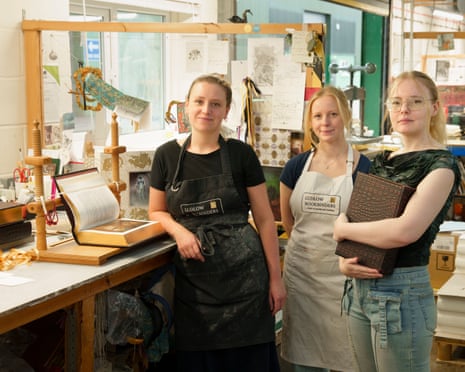
"People are discovering that, as everything is already decided for you by a computer or algorithm, being able to make or own something physically is good," Lawley said. "And it is very satisfying to repeat a task to perfection. It is meditative as a job so it is extremely low-cortisol."
An industry that nearly lost its transmission
Paul Kidson, Ludlow's chief executive and a fourth-generation bookbinder, describes the influx of interest as a lifeline for a rapidly shrinking trade. He estimates there are now fewer than 50 handcraft bookbinders operating in Britain.
"British bookbinding has a terrific reputation across the world, but like so many things in the 50s, 60s and 70s, the training just started to dry up," Kidson said. "All the formal apprentice schemes collapsed in the early 1980s, and the industry got no training at all."
The consequence is that firms now have to train from scratch. "We have to train our own people because you can't recruit at volume because there aren't any [courses]," he said.
The limits of the strategy
It would be easy to over-read this as a solution. It is not one, for a straightforward reason: fewer than 50 practitioners is not a labour market.
Heritage crafts are AI-proof precisely because they are small, slow and physical — the same properties that cap how many people they can absorb. They cannot take up the slack from three million automated roles, and the apprenticeships that exist are limited by how many masters are available to teach.
What the trend does reveal is a judgement being made by people at the start of their working lives. Asked to bet on which skills will still be valuable in twenty years, a number of graduates are concluding that the safest answer is the work a machine cannot physically perform — and that the credential they already hold offers less protection than a pair of trained hands.
More from peatpost

'Clearly, People Hate Data Centers': Altman Concedes the Backlash
Seven in ten Americans oppose one being built near them. At least 48 projects worth $156bn have already been blocked or stalled.

Former Barclays Chief Questioned Under Oath Over Epstein Emails
Newly released transcripts show US lawmakers pressing Jes Staley on 2010 exchanges. He denies the central allegation.

Nvidia's $12.9bn Move for Hugging Face Would Put Silicon and Distribution Under One Roof
The largest GPU maker buying the largest open-model hub would concentrate the entire open-source AI pipeline inside one company.
Discussion
0 commentsNo comments yet — be the first to weigh in.